
Greater Moncton Real Estate Blog

RSS

What Salary Do You Need to Buy a House in Moncton? (2026)

Do you need to make six figures to buy a house in Greater Moncton?

Not necessarily.

CREA's August 2026 numbers put the average residential sale price in Moncton and Area at $374,090. At that price, with 5% down, you're looking at roughly $86,000 to $91,000 in gross household income to qualify, depending on your amortization. At the regional median of $357,000, that drops to somewhere around $82,500 to $87,200.

That's household income, not what one person needs to bring home, and it's not a promise that you'll enjoy spending what the bank is willing to lend you. Those are two different numbers, and mixing them up is how people end up house-poor.

A handful of things move that number around considerably: your down payment, your existing debt, your amortization, and Canada's mortgage stress test. And because Greater Moncton isn't one neighbourhood with one price tag, where you buy matters too. Let's get into it.

WHAT SALARY DO YOU NEED TO BUY IN MONCTON, RIVERVIEW OR DIEPPE

A regional average papers over the fact that Moncton, Riverview, and Dieppe are three different markets with three different price points. Using CREA's August 2026 median residential sale price for each town, here's roughly what a household needs to earn to qualify with 5% down and no other debt.

  • Moncton: median $369,500. About $85,300/year at 30 years, $90,100/year at 25.

  • Riverview: median $350,000. About $81,200/year at 30 years, $85,700/year at 25.

  • Dieppe: median $392,500. About $90,500/year at 30 years, $95,600/year at 25.
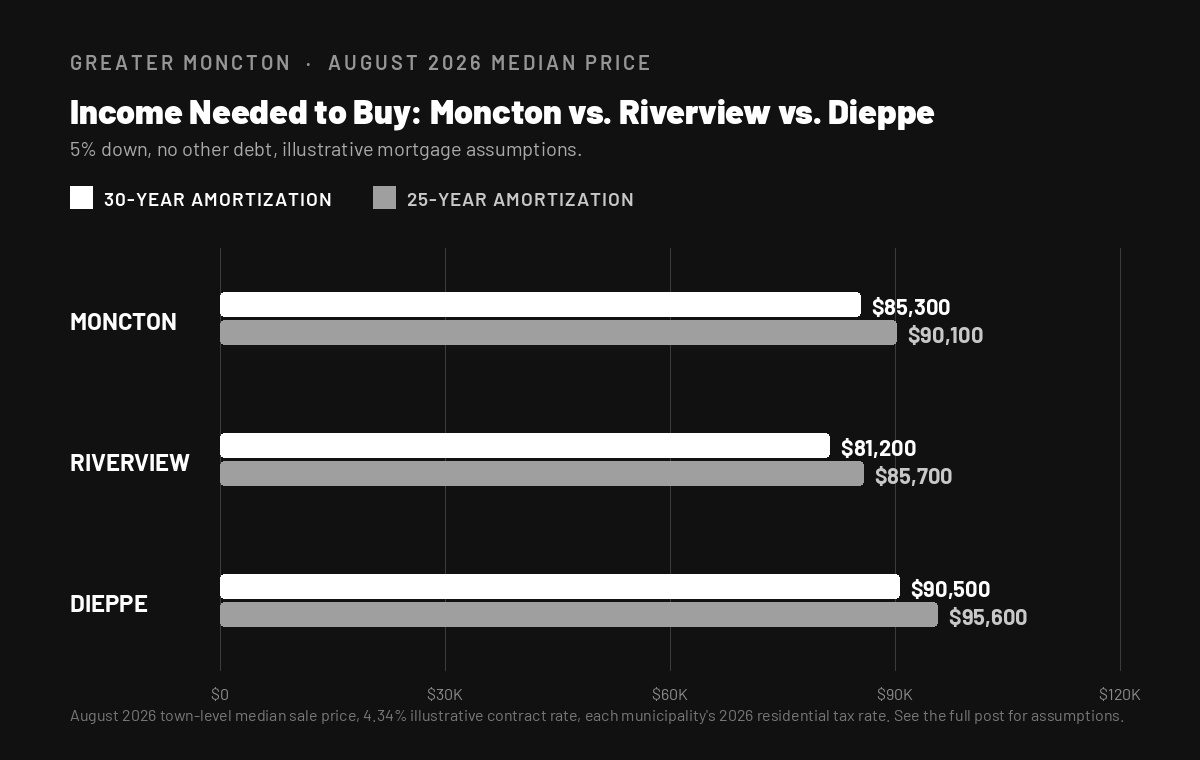
Property tax isn't what's driving that gap, the three towns' rates are within a hair of each other. Purchase price is doing all the work. Based on August's numbers, Riverview is the cheapest way into Greater Moncton by a meaningful margin, and Dieppe is the most expensive of the three.

Don't pack the moving truck yet, though.

WHY "MEDIAN RESIDENTIAL" DOESN'T MEAN "DETACHED HOUSE"

Those medians cover every residential property type that sold in August, not just detached houses, and the mix isn't the same in every town. Pull out single-detached sales specifically and the picture changes: Moncton's detached median was $358,000, on 49 sales. Riverview's was $372,450, on 14 sales. Dieppe's was $429,250, on just 9 sales. [Source: CREA, Moncton and Area Residential Market Activity, August 2026.]

Notice that Moncton's detached median actually came in below its overall residential median. That's not a typo, with only 90 total residential sales in Moncton that month against 49 detached ones, the other 41 sales (condos, townhomes, semi-detached, the rest of the mix) skewed the blended number upward. A single month's numbers can shift on a handful of sales, particularly in Riverview and Dieppe where detached sale counts were in the single and low double digits. Useful starting points, not gospel.

And even within Moncton, a bungalow in Moncton Centre and a newer two-storey in Moncton North aren't the same conversation. For the sub-area breakdown, my August 2026 Moncton market update covers all 13.

THE MORTGAGE STRESS TEST: WHY YOU DON'T QUALIFY AT THE RATE YOU'RE QUOTED

Here's where a lot of buyers get tripped up. You sit down with your broker or your bank's mortgage specialist, get quoted a rate, do the payment math in your head, and figure you're in good shape. Except that's not the rate most lenders actually qualify you at.

Federally regulated lenders, and every insured mortgage regardless of lender, have to qualify you at whichever is higher: your contract rate plus 2%, or 5.25%. That's the OSFI minimum qualifying rate, and it's been the standard for years. Offered a mortgage at 4.34%? You're qualified as if you were paying 6.34%. You're not actually paying that, you're being tested against it, on the theory that you should be able to absorb higher rates or a change in your finances without the whole thing falling apart.

It's why a payment that looks perfectly manageable on paper doesn't always translate into approval for the price you had in mind. Some credit unions and alternative lenders play by different rules, but the federal stress test is what most Moncton buyers are actually up against.

YOUR DOWN PAYMENT, AND WHY MORTGAGE INSURANCE COSTS MORE THAN PEOPLE THINK

Canada's minimum down payment rules are simple enough: 5% on the first $500,000, 10% on the portion between $500,000 and $1.5 million, and at least 20% above $1.5 million, where standard mortgage default insurance stops being available at all.

Here's the part people skip past. Put down less than 20% and you need mortgage default insurance, and that insurance isn't a rounding error. On the $374,090 example, 5% down is $18,705, leaving a base mortgage of $355,385. At a 25-year amortization, CMHC's premium at that loan-to-value is 4%, adding roughly $14,215 to the mortgage. Choose an eligible 30-year amortization instead, and CMHC tacks on a further 0.2-point surcharge, 4.2% total, about $14,926.

Your mortgage ends up bigger than your purchase price minus your down payment, because the premium usually gets rolled into the loan rather than paid separately at closing. You pay interest on it too.

SHOULD YOU CHOOSE A 25-YEAR OR 30-YEAR MORTGAGE

Since December 15, 2024, eligible first-time buyers can get a 30-year insured mortgage on resale or new construction, and buyers of new construction can access one even if they've owned before. Buyers putting 20% or more down may get a longer amortization through a conventional mortgage too, depending on the lender.

On the $374,090 example at 4.34%, 5% down, here's what actually changes:
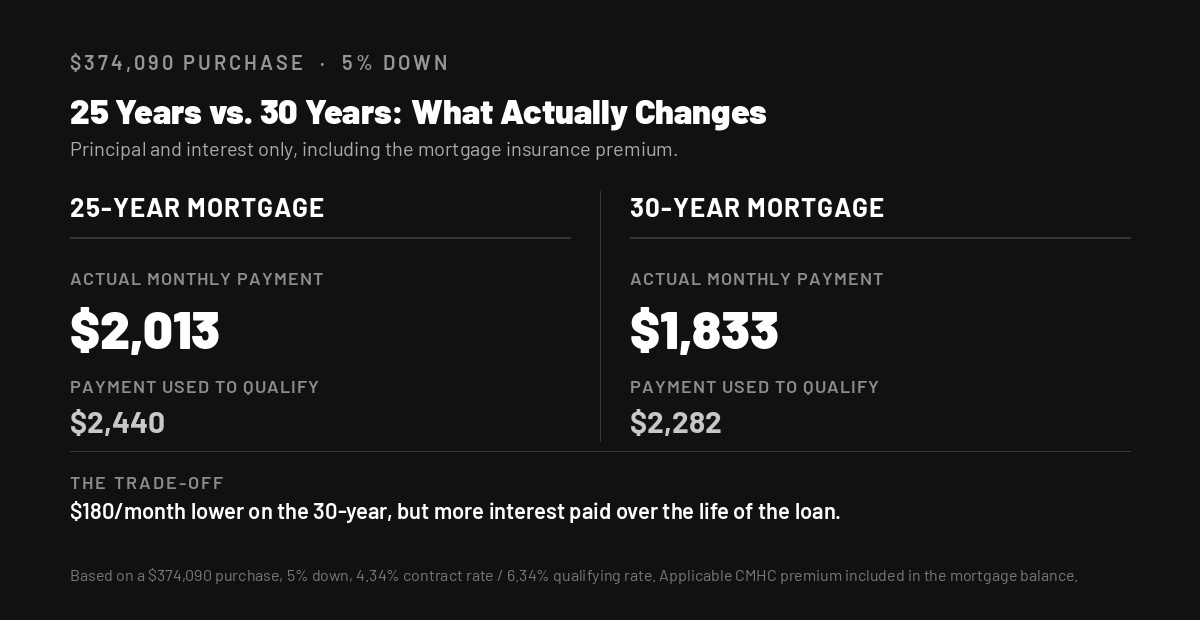
Thirty years drops your actual payment by about $180 a month and lowers the income needed to qualify. The trade-off is real: stretching the loan out means considerably more interest paid over its life, and because most Canadian mortgages renew before the amortization is up, your total interest cost down the road also depends on where rates go from here. If you're eligible, it's worth a real conversation with whoever's arranging your mortgage about both options, not a reflex toward the lower payment.

WHAT A CAR PAYMENT DOES TO YOUR BUYING POWER

Your mortgage isn't the only thing a lender looks at. They run two ratios: Gross Debt Service and Total Debt Service. GDS covers your housing costs, mortgage payment at the qualifying rate, property tax, heating, half of any condo fee, capped at 39% of gross household income. TDS adds everything else you owe, car payment, student loan, credit cards, lines of credit, capped at 44%.

This is where that new truck in the driveway starts causing real problems. Take the $374,090 home, 30-year amortization, no other debt: $86,400 in required income. Add a $600/month vehicle payment and that number jumps to $92,900, about $6,500 more, from one payment. If you're planning to buy in the next year or two, paying down debt before you apply does more for your buying power than almost anything else you actually control.

QUALIFYING FOR A MORTGAGE AND HAVING CASH TO CLOSE ARE TWO DIFFERENT THINGS

Getting approved is one hurdle. Having the cash in hand on closing day is another, and people conflate them constantly.

On the $374,090 example: 5% down is $18,705. New Brunswick's real property transfer tax, 1% of the purchase price or the assessed value, whichever is higher, adds another $3,741. That's $22,446 before legal fees, inspection costs, adjustments, moving expenses, or the emergency fund you'll want after the move. Your lawyer will give you an exact number, but budget for this separately from your down payment, it's the part people forget.

A NOTE ON PROPERTY TAXES, AND THE 2026 ASSESSMENT FREEZE

The numbers in this article use each town's 2026 municipal residential rate: $1.3614 per $100 of assessed value in Moncton, $1.3826 in Riverview, and $1.3650 in Dieppe. All three assume you're buying it as your principal residence and eligible for New Brunswick's Residential Property Tax Credit, which zeroes out the provincial portion on the first half-hectare around your home. For simplicity, these examples assume assessed value equals purchase price, your actual bill may differ.

One more thing worth knowing before you assume your tax bill will match the current owner's: New Brunswick froze most 2026 assessments, but sales and transfers are specifically excepted. Buy the place, and your assessment can update even while your neighbour's stays frozen. Don't take the seller's current tax bill as a preview of your own.

WHAT THIS MEANS IF YOU'RE PLANNING TO BUY

None of this replaces an actual mortgage pre-approval. What it gives you is a realistic starting point before you fall for a house that's outside your range. Talk to a mortgage specialist or broker early, find out your real buying power, and separately, decide what payment you're actually comfortable carrying. Those two numbers aren't always the same one.

If you're a first-time buyer or looking at new construction, ask specifically about the 30-year amortization, not every lender leads with it. And if you've got a house that needs to sell before this next purchase happens, the order of operations changes. I've written about how to structure buying before your current home sells if that's you.

Because what you can afford in one corner of Greater Moncton can look very different from what the same money buys ten minutes away.

A COUPLE OF QUICK ANSWERS

Can I buy a house in Moncton on $80,000 household income?

  • Potentially, yes. With 5% down, no other debt, and an eligible 30-year amortization, $80,000 gets you to roughly $345,000 in purchase price under these assumptions. That's real inventory, just not the regional average.

Does a bigger down payment lower the income I need?

  • Considerably. Move from 5% down to 20% on the $374,090 example and CMHC insurance disappears entirely. Required income drops to roughly $73,000 at 30 years or $77,000 at 25, assuming your lender offers the longer conventional amortization. Meaningful, if you've got the savings or equity to get there.

Thinking about buying in Greater Moncton and want to know what your budget can realistically get you?

Call or text 506-852-6477. No pressure, just straight answers.

Strong Roots - Smart Moves

Shane MacPherson, REALTOR®, eXp Realty

Read

Should You Wait for Lower Rates to Buy in Moncton?

WAITING FOR RATES TO DROP ISN'T A PLAN. IT'S A GUESS.

I keep hearing some version of the same thing from buyers right now: "We're going to wait until rates come down."

Fair enough, rates might come down. The problem starts when "might" quietly turns into "will," and six months later somebody has built their entire home-buying plan around an interest-rate prediction nobody actually made.

There are plenty of legitimate reasons to wait to buy a house. Maybe the payment doesn't work. Maybe you need a bigger down payment. Maybe you're carrying debt you should probably deal with first. Maybe your job situation isn't stable enough yet. Maybe every house you've looked at lately is overpriced, poorly maintained, and somehow still has twelve shades of grey laminate flooring.

Wait.

But if your whole plan is, "Rates will definitely be lower next spring," understand what you're actually doing. You're not avoiding a gamble, you're making one.

WHAT THE BANK OF CANADA ACTUALLY SAID

On September 2, 2026, the Bank of Canada held its overnight rate at 2.25%.

More importantly, it said the upside risks to inflation had increased. The Bank specifically pointed to things like elevated oil prices and new tariffs that could add to business costs and keep inflation pressure higher than expected. Its position going forward was basically what you'd expect from a central bank: they'll keep watching the economy and inflation and adjust policy if they need to.

In other words, they didn't promise another cut, and they didn't say a hike is coming either. They don't know yet, which is mildly inconvenient considering half the internet apparently does.

That's the part buyers need to understand. Nobody at the Bank of Canada is standing there saying, "Hang tight until March and we'll knock 75 basis points off for you." If somebody is telling you rates are definitely going lower, they're predicting. Maybe they'll be right, maybe they won't.

WHY "I'LL WAIT FOR RATES TO DROP" WAS NEVER REALLY A STRATEGY

Interest rates matter, obviously. A lower mortgage rate can reduce your monthly payment and the total amount of interest you pay over time. On a mortgage of several hundred thousand dollars, even a modest change matters.

But buying a house involves more than one number. You're not just watching mortgage rates, you're also watching house prices, inventory, competition, your own income, your debt, your down payment and what sellers are willing to negotiate. All of those things move, and they don't move together just to make your life easier.

  • Rates could come down while prices rise.

  • Rates could stay flat while inventory keeps growing and sellers get more flexible.

  • Rates could come down and suddenly a bunch of buyers who have also been "waiting for rates to drop" pile back into the market at the same time.

Or none of that could happen. That's the point. Waiting gets treated like the safe option because technically you're doing nothing, but doing nothing is still a decision.

WHAT'S ACTUALLY HAPPENING IN GREATER MONCTON

This is where the local numbers matter more than some national headline written for Toronto, Vancouver and the rest of Canada all at once.

Greater Moncton has softened: by August, there were 1,585 active residential listings, up 6.3% from August 2025. Months of inventory had climbed to 6.2 from 5.0 a year earlier. Sales were down 15.3% year over year, and the median days on market had increased to 47 from 42.

That's not a booming seller's market, and frankly, buyers should be happy about that. There is more inventory. Houses are taking longer to sell. Sellers are having to compete for buyers again. Buyers have more time to think, more opportunity to negotiate and, in some cases, more ability to walk away from a seller who still thinks it's 2021.

The market has been moving in that direction through the summer. Months of inventory sat at 4.8 in May, 4.5 in June, 4.9 in July and then jumped to 6.2 in August. Median days on market moved from 29.5 days in May to 36 in June, 38 in July and 47 in August.

That's good news for buyers, and it also means the lazy "BUY NOW BEFORE PRICES EXPLODE" pitch is nonsense. But so is assuming the opposite.

PRICES HAVEN'T EXACTLY FALLEN THROUGH THE FLOOR EITHER

Here's where the story gets more interesting.

The average residential sale price in Greater Moncton in August was $374,090, down 3.5% from August 2025. The median was $357,000, down 1.6%. So yes, prices were softer in August, but one month is one month.

Looking at the first eight months of 2026 gives a better picture. The year-to-date average price was $383,191, down just 1.0% from the same period last year. The year-to-date median was $361,500, actually up 0.3%. That's not a crash, and it's not a runaway market either. It's a market where inventory has increased, sales have slowed, buyers have more leverage, and prices are proving a lot stickier than some people expected.

Which brings us back to waiting for rates. If you're sitting on the sidelines because you believe mortgage rates are about to drop and Moncton house prices are about to collapse at the same time, neither half of that theory has happened yet. Could it? Sure, but that's a prediction too.

A BANK OF CANADA CUT DOESN'T AUTOMATICALLY MEAN YOUR MORTGAGE RATE DROPS THE SAME AMOUNT

There's another piece of this that gets butchered constantly.

The Bank of Canada's overnight rate is not your mortgage rate.

Changes to the overnight rate have a more direct impact on prime lending rates and variable-rate mortgages. Fixed mortgage rates are influenced by other things too, including bond yields, lender funding costs and what financial markets expect inflation and interest rates to do next. So if the Bank of Canada cuts by 0.25%, that does not automatically mean your five-year fixed mortgage drops by 0.25% the next morning.

  • Sometimes fixed rates move before the Bank does because markets are anticipating a change.

  • Sometimes they don't move much at all.

  • Sometimes other pressures are pushing in the opposite direction.

Mortgage pricing is annoyingly more complicated than "Bank cuts, mortgage cheaper," because apparently somebody felt buying a house needed another layer.

THE MATH THAT ACTUALLY MATTERS

Here's what I'd be doing instead of trying to predict the next Bank of Canada meeting: run your numbers based on the mortgage rates that actually exist today.

What can you comfortably afford? Not what the bank says you can technically qualify for. What can you actually live with every month after the mortgage, property taxes, heating, insurance, maintenance and the usual pile of expenses nobody remembers until they own the house.

  1. How much cash will you have left after the down payment and closing costs?

  2. Are you carrying high-interest debt?

  3. Is your employment stable?

  4. Are you planning to stay in the area long enough for buying to make sense?

Those are real questions. A mortgage broker can run those numbers with you using today's rates, your actual income and your actual debt. I also have a mortgage calculator on my website if you want to start playing with the numbers before having that conversation.

If the numbers work comfortably today and you find the right house, I wouldn't automatically put your life on hold waiting for a future mortgage rate that may or may not show up. If the numbers don't work today, that matters too. Don't force it.

SOMETIMES WAITING IS ABSOLUTELY THE RIGHT MOVE

I don't subscribe to the usual real estate nonsense that "it's always a great time to buy." It isn't. Sometimes buying a house is a terrible idea.

  • If the payment is going to leave you broke every month, wait.

  • If buying wipes out every dollar you have, wait.

  • If you have a pile of expensive consumer debt, maybe deal with that before celebrating home ownership with an empty bank account.

  • If you're not sure you even want to stay in Moncton, don't buy a house because somebody told you renting is "throwing money away." That line should have been retired around the same time as vertical blinds.

And if the only houses you can afford are houses you don't actually want, there is no prize for buying one anyway.

The point of this article is not that you should buy now. The point is that waiting because your financial situation says "not yet" is very different from waiting because you've convinced yourself you know where interest rates are going.

One is planning. The other is guessing.

THE PART NOBODY LIKES: THERE IS NO PERFECT TIME

This is the frustrating part. There is no bell that rings at the bottom of the market, and there's no email from the Bank of Canada saying, "Congratulations, Shane, this is officially the cheapest possible week to borrow money for the next ten years."

You make the best decision you can with the information you have at the time. Right now, the Greater Moncton market is giving buyers more selection, more time and more negotiating power than they had a few years ago. At the same time, prices have not collapsed, and the Bank of Canada is not promising lower rates. That isn't good news or bad news, it's just the market, and markets are messy.

THE BOTTOM LINE

Should you wait for lower rates before buying a home in Moncton?

Maybe.

But don't wait simply because you've decided rates are definitely coming down. The Bank of Canada held its overnight rate at 2.25% in September and said inflation risks had increased. Greater Moncton inventory is up, sales are slower and homes are taking longer to sell. Prices have softened in some areas, but broadly speaking they have not fallen off a cliff. That's the reality.

If buying works for your finances today and you find the right property, don't let somebody else's interest-rate prediction make the decision for you. If buying doesn't work today, don't force it either. Keep saving. Pay down debt. Improve your position. Keep watching the market.

Just make sure you're waiting for a reason you can actually explain, not because somebody online promised you rates would be lower by spring.

Those people are remarkably hard to find when spring arrives.

If you want to find out what your actual numbers look like right now, today's rate, not a guessed-at one, that's a fifteen-minute conversation, not a commitment.

Call or text 506-852-6477. No pressure, just straight answers.

Strong Roots - Smart Moves

Shane MacPherson, REALTOR®, eXp Realty

Read

New Brunswick Oil Tanks: What Sellers Get Wrong

Your Oil Tank Can Kill a Deal Faster Than You Think

It's there. It holds oil. The furnace works. Everybody carries on with their life.  Then a buyer comes along, their insurance company asks how old the tank is, and suddenly the rusty metal box in the basement is running the whole transaction.

If your home is heated with oil, especially in places like Salisbury, Memramcook, Cocagne and a lot of rural New Brunswick, this is something worth figuring out before you list.  Not after you have an accepted offer. Not three days before conditions are due. And definitely not when the buyer's lender, insurance company, lawyer and REALTOR® are all suddenly asking questions you don't have answers to.

WHY THE OIL TANK EVEN MATTERS

Most buyers aren't showing up with a suitcase full of cash. They're getting a mortgage.

And in most financed purchases, the lender wants confirmation that the property can be insured before they'll release mortgage funds. So if the insurance company has a problem with your oil tank, the lender may have a problem with the house.

And once the lender has a problem, everybody has a problem.

You'll sometimes hear people throw around numbers like 15 years for an exterior tank and 25 years for an interior tank. Those numbers have been used as general insurance-industry benchmarks, but they are not New Brunswick law and they are not universal cut-offs.

Insurance companies make their own underwriting rules. The material of the tank matters. Where it is located matters. Its construction matters. Its condition matters. Some modern double-wall, fibreglass and composite tanks can have significantly longer acceptable service lives than traditional steel tanks.

So the useful question isn't, "Is my tank more than 15 years old?"

The useful question is, "Will a buyer be able to insure this house with this tank?"

That's the question that can affect your sale.

NOT KNOWING THE AGE ISN'T A GREAT ANSWER

One of the worst answers a seller can give when asked about an oil tank is, "No idea. It was here when we bought the place."

It may be completely true.  It's also completely useless.

There is a significant difference between saying, "It was installed in 2014 and here's the invoice," and saying, "Could be 12 years old. Could be 32. Your guess is as good as mine."

If you have paperwork, find it before the property hits the market. An installation receipt, replacement invoice, previous inspection or the manufacturer's label can all help establish the tank's age.  Insurance companies tend to deal better with facts than folklore.

YES, THESE THINGS ACTUALLY LEAK

This isn't just insurance-company bureaucracy invented to ruin everybody's afternoon.

Nearly 40% of all oil spills reported to New Brunswick's Department of Environment and Local Government each year come from domestic oil tanks at private homes.  Outside tanks can develop condensation. Steel can corrode. Supports can fail. Fuel lines can leak. And sometimes the exterior of a tank looks perfectly fine while corrosion is occurring internally.

So standing beside it, kicking the leg and announcing, "Looks good to me," probably isn't enough.  That's how guys assess used lawn tractors.

The province recommends homeowners regularly inspect their tanks and have them professionally inspected annually by a licensed installer.

WHO GETS STUCK WITH THE CLEANUP?

This is where the conversation can get considerably more expensive than simply replacing an oil tank.

Under New Brunswick's Clean Environment Act, the province can potentially look to several different parties when contamination is discovered. That can include the person who caused the release, certain previous owners, and the current owner or occupier of the property.  

That does not mean the current owner automatically becomes responsible for every spill that ever occurred on the property.  But it does mean buying a property doesn't necessarily give you a clean slate if someone buried an oil tank in 1987, removed it badly, or allowed fuel to contaminate the surrounding soil.  

If there is evidence of an old underground tank, previous leakage or contaminated soil, stop guessing. That is the point where proper environmental and legal advice becomes considerably more useful than somebody's uncle telling you what happened with his neighbour's house twenty years ago.

WHAT ABOUT THE 2,000-LITRE RULE?

Another thing that gets misunderstood is New Brunswick's petroleum storage licensing requirement.

The province requires a petroleum storage site licence for systems with a total capacity of 2,000 litres or more.

Most typical residential heating-oil tanks fall below that threshold, so the average homeowner with a standard tank isn't unknowingly operating an illegal petroleum facility in the basement.  But being below 2,000 litres does not mean there are no rules or no consequences.  If a residential tank leaks, it is still petroleum contamination.

Apparently oil does not become environmentally friendly because the tank was 1,100 litres too small to require a provincial licence.

WHAT ABOUT THE PROPERTY DISCLOSURE STATEMENT?

I've already written about New Brunswick's Residential Property Disclosure Statement before.

The RPDS is not automatically required in every residential transaction. That does not mean sellers should suddenly develop selective amnesia.  There is a meaningful difference between genuinely not knowing something and knowing about an issue but hoping nobody asks the right question.  If you know an oil tank has leaked, know there was previously an underground tank, know contaminated soil was discovered, or know there is an unresolved environmental concern, that needs to be taken seriously.  And if you're unsure what your legal disclosure obligations are, that's where your lawyer comes in.

I'd much rather have a seller spend a few minutes getting proper advice before listing than have lawyers discussing the same issue after closing.

Lawyers are great.

They're just considerably less enjoyable when they're billing you.

WHAT SHOULD YOU ACTUALLY DO BEFORE LISTING?

Start by figuring out how old the tank is.

Check the manufacturer's label. Look through the paperwork from when you purchased the home. Find installation invoices, service records or replacement receipts.  Then actually look at the thing.  Pay attention to corrosion, staining underneath or around the tank, unusual oil smells, damaged supports, cracks, dents or anything else that seems questionable.  If the tank is older, its age can't be established, or something simply doesn't look right, have someone qualified inspect it before you list the property.

Not after you receive an offer.

Before.

If the answer comes back that the tank needs replacement, you can deal with it calmly and make an informed decision.  That is considerably easier than discovering the problem while a buyer's financing and insurance conditions expire in 48 hours.

One is home maintenance.

The other starts to feel suspiciously like a hostage negotiation.

WHAT IF THE TANK NEEDS TO BE REPLACED?

Then deal with it.  Seriously.

A seller replacing an aging tank before listing is inconvenient.

A seller trying to replace one during conditions while the buyer's lender and insurance company are waiting for documentation is considerably more inconvenient.  

If the tank is nearing the end of its usable life anyway, it may also be the right time to look at whether continuing with oil makes financial sense.  That doesn't automatically mean ripping out a perfectly functioning heating system because somebody on Facebook bought a heat pump.  It just means look at the options before spending money replacing one component of a system you may already have been considering changing.

THINKING ABOUT GETTING RID OF OIL COMPLETELY?

If you're already considering replacing the oil tank or heating system, check the current SaveEnergyNB programs before assuming the entire cost will come out of your pocket.  The Oil to Heat Pump Affordability advance-payment stream stopped accepting new registrations in June 2026, but other heat-pump incentives remain available through SaveEnergyNB programs.

The important word there is current.

Government programs change. Rebates change. Eligibility changes.  So don't base a five-figure heating decision on what your neighbour's cousin received three years ago.  Check what is actually available when you're ready to do the work.

THE BOTTOM LINE

Having an oil tank isn't automatically a problem.  Having an old, undocumented, questionable oil tank can be.  And the worst time to discover that is after you've accepted an offer and everyone suddenly realizes the buyer may not be able to insure the property.

Before you list an oil-heated home, know the age of the tank. Know its condition. Know whether there are likely to be insurance issues. Keep whatever documentation you have.

It's not exciting real estate advice.  It's just one of those boring little things nobody worries about until it starts threatening a $400,000 transaction.

Then, strangely enough, everybody cares.

If you're thinking about selling and want someone to go through this stuff before it becomes a problem, give me a call.  I'll tell you what I think needs attention, what I wouldn't waste money on, and what may actually matter when a buyer, inspector, insurer or lender starts asking questions.

No pressure, just straight answers.

Shane MacPherson, REALTOR®, eXp Realty

506-852-6477

Strong Roots - Smart Moves

Read

Moncton Market Update August 2026: All 13 Sub-Areas Rated

One Region. Four Markets. And a Whole Lot of Different Stories.

One region. Four main markets. Thirteen local pockets. And seven of those thirteen didn’t even crack 10 sales in August. That should probably tell you something before we even get started.

August was quiet across most of Greater Moncton. Sales dropped, inventory kept building, and you now have to go all the way back to August 2019 to find an August with more homes sitting on the market than we had this month.

And Dieppe, which was one of the hottest parts of the region a month ago, went from WARM to COLD. Not “showing signs of moderation.” Not “transitioning toward balance.” Cold.

Here’s what actually happened, area by area. No spin. No pretending every statistic is somehow good news. Just the numbers and what they mean.

Quick key before you scroll:

  • HOT: Sellers are firmly in control. Buyers need to come prepared.

  • WARM: Still favours sellers, but buyers can breathe.

  • BALANCED: Pretty much a fair fight.

  • COOLING: Buyers are gaining leverage.

  • COLD: Buyers are holding most of the cards.

  • TOO SMALL TO RATE: Fewer than 10 sales. Pretending six transactions accurately describe an entire neighbourhood is how bad statistics become Facebook posts.

GREATER MONCTON: COOLING

255 sales | $374,090 average | $357,000 median | 6.2 months of inventory | 47 days on market

Sales fell 15.3% from last August while active listings climbed to 1,585. You have to go back to August 2019 to find an August with more homes for sale.

Average price fell 3.5%. Median price slipped just 1.6%. And here’s why I don’t obsess over average price: the MLS Home Price Index benchmark sits at $378,700, which is actually up 4.4% from last year. At the same time, it’s down 1.5% from last month and 6.3% over the past three months.

Same market. Three different stories depending on which statistic somebody decides to throw at you.  The average doesn’t lie. It just gets pushed around by whatever happened to sell that month, which is why one headline number rarely tells you much.

MONCTON: COOLING

90 sales | $403,538 average | $369,500 median | 5.5 months of inventory | 49 days on market

Sales were down 9.1%, and homes are taking considerably longer to move. Moncton is not the screaming seller’s market a lot of people still seem to think it is.

That doesn’t mean houses aren’t selling. It means the wrong house at the wrong price isn’t getting rescued by the market anymore.

Moncton North: WARM

42 sales | $418,113 average | $382,375 median | 3.4 months of inventory | 51.5 days on market

Inventory says WARM. Almost everything else tells you to pump the brakes.

Average price fell roughly 10.5%. Median price fell about 9%. And homes took 51.5 days to sell compared with just 21 days last August.  Still competitive? Absolutely. Automatic multiple offers because the photographer remembered to turn the lights on? Those days are behind us.

Moncton East: COOLING

24 sales | $444,506 average | $397,500 median | 5.8 months of inventory | 48.5 days on market

Interestingly, prices actually increased here. Average price rose 9.6% and median price increased 4.6%.

But active inventory climbed, months of inventory increased from 4.4 to 5.8, and homes took longer to sell. Higher prices do not automatically mean a stronger market. Buyers have more to choose from and more room to negotiate.

Moncton Center: COLD

18 sales | $346,389 average | $347,000 median | 11.4 months of inventory | 54 days on market

Sales fell 41.9%. There were 205 active listings against just 18 sales, which works out to 11.4 months of inventory.

People keep asking whether there’s anywhere in Greater Moncton that is legitimately a buyer’s market. Yep. There it is.  And if your listing has been sitting since spring, the market isn’t necessarily the only problem.

The Real Cost of Overpricing Your Home in Greater Moncton

Moncton West: TOO SMALL TO RATE

Six sales.  That’s not a market sample. That’s a dinner reservation. Moving on.

DIEPPE: COLD

25 sales | $416,930 average | $392,500 median | 8.5 months of inventory | 43 days on market

This one deserves attention. Sales fell 26.5%. Active listings climbed 21.7%. Months of inventory hit 8.5 compared with 5.1 last August.

And last month Dieppe was sitting at only 3.7 months of inventory.  One month does not make a trend, but going from 3.7 months to 8.5 months in thirty days isn’t something you casually wave away either.

Dieppe didn’t gently cool off in August. Someone opened the freezer door.

Dieppe Fox Creek: COOLING

12 sales | $458,192 average | $396,250 median | 5.5 months of inventory | 25.5 days on market

This was one of the hottest spots in the entire region last month. When homes sell here, they’re still moving quickly. Twenty-five days is fast in this market.  There’s simply less selling happening. Sales fell 25%, while 66 homes were sitting active against those 12 sales.

Still a good market. Just not the feeding frenzy it was.

Dieppe Chartersville: TOO SMALL TO RATE

Six sales.

But there’s still something worth noticing. Active listings jumped 87.8% from last August and inventory climbed from 6.8 months to 12.8 months.

Six sales isn’t enough for me to slap a confident market label on it. Twelve months of inventory is enough to make me pay attention.

Dieppe Center: TOO SMALL TO RATE

Seven sales.  

Average price rose 5.6%, but months of inventory climbed from 5.1 last August to 9.0 this August.  Again, seven sales can do funny things to averages. Don’t build an entire market narrative around seven houses.

Dieppe East: TOO SMALL TO RATE

Zero sales. Two new listings. Seven active listings.

Hard to calculate what the market is doing when nobody actually bought anything.

RIVERVIEW: BALANCED

21 sales | $378,176 average | $350,000 median | 4.0 months of inventory | 34 days on market

Last month Riverview was running at only 2.3 months of inventory. Now it’s at 4.0.  That’s a substantial change in thirty days, especially with sales down 30%.

Still healthy. Still moving. Just nowhere near as lopsided in the seller’s favour as it was.

Riverview West: TOO SMALL TO RATE

Eight sales.  That’s down from 17 last August, a decline of roughly 53%.  Some of the price numbers look strong, but eight sales can make an average price dance around like it’s had three Caesars. Don’t overread it.

Riverview East: HOT

10 sales | $332,740 average | $343,500 median | 1.5 months of inventory | 37 days on market

Ten transactions is the absolute minimum I’m willing to rate, but at 1.5 months of inventory this remains the tightest rated pocket in the region.  This is one of the few places where sellers can still reasonably expect buyers to compete.  That still doesn’t mean you can price your house like you’ve been drinking. There are limits.

Riverview Center: TOO SMALL TO RATE

Three sales.  

There is nothing statistically responsible I can tell you about an entire market based on three people buying houses.

SHEDIAC AND COAST: COOLING

31 sales | $424,706 average | $425,000 median | 5.7 months of inventory | 55 days on market

Finally, somebody sold more houses than last August.

Sales rose 6.9%, making Shediac and the coast one of the few genuine bright spots for transaction volume this month. Homes still took 55 days to sell, but that’s a hell of an improvement from 79 days last August.

Shediac East / Cap-Pelé: TOO SMALL TO RATE

Six sales.

Sales increased from five to six, technically a 20% increase. Which is also a fantastic demonstration of why percentages without context can be ridiculous.  Inventory sits at 8.3 months and the average sale-to-list ratio came in below 94%.

Small sample, yes. But in that small sample, sellers weren’t exactly naming their price.

THE DETACHED HOME MARKET TOOK A BIGGER HIT

This one deserves its own section.  Single-detached sales fell 24.1% from last August, with 176 homes sold. Overall residential sales dropped 15.3%.  So if you’re trying to sell a detached home right now and it feels noticeably slower out there, you’re not imagining it. That segment took a materially bigger hit than the market overall.

But here’s where things get interesting.

Semi-detached sales went completely the other direction. Forty-nine semis sold in August, up 48.5% from last year. 

Think about that for a second:

  • Detached home sales: down 24.1%

  • Semi-detached home sales: up 48.5%

Same region. Same month. Two completely different markets.

Which is exactly why saying “the Moncton market is hot” or “the Moncton market is slow” doesn’t tell you nearly enough anymore.

SO WHAT DOES ALL OF THIS ACTUALLY MEAN?

There isn’t one Greater Moncton real estate market.  There are markets inside markets inside markets.

A seller in Riverview East is dealing with 1.5 months of inventory. A seller in Moncton Center is staring at 11.4.

Those two people are not participating in remotely the same real estate market, regardless of what some national headline tells you happened to Canadian housing this week.

And that’s really the point of digging through 365 pages of CREA data.

13 Sub-Markets. Zero Guessing.

The headline number is interesting. Your neighbourhood is useful.  Your property type matters. Your price range matters. Your competition matters. And increasingly, all of those things matter a hell of a lot more than someone saying, “The Moncton market is up 4%.”

Up where? For what? Compared to what?

That’s the part that actually matters.

CREA tracks the national numbers as well if you want to see how Moncton and Area compares with the rest of Canada:

CREA Housing Market Stats

If you want to know what the numbers actually mean for your house, your neighbourhood and what you’re trying to do, call or text 506-852-6477.

No pressure. Just straight answers.  Even when the answer isn’t the one you were hoping for.

Strong Roots - Smart Moves

Shane MacPherson | REALTOR® | eXp Realty (506) 852-6477

Source: CREA Moncton and Area Residential Market Activity and MLS® HPI Report, August 2026. Sub-areas with fewer than 10 monthly sales are flagged rather than rated, because small samples make unreliable trends.

Read
The trademarks REALTOR®, REALTORS®, and the REALTOR® logo are controlled by The Canadian Real Estate Association (CREA) and identify real estate professionals who are member’s of CREA. The trademarks MLS®, Multiple Listing Service® and the associated logos are owned by CREA and identify the quality of services provided by real estate professionals who are members of CREA. Used under license.