

Do you need to make six figures to buy a house in Greater Moncton?
Not necessarily.
CREA's August 2026 numbers put the average residential sale price in Moncton and Area at $374,090. At that price, with 5% down, you're looking at roughly $86,000 to $91,000 in gross household income to qualify, depending on your amortization. At the regional median of $357,000, that drops to somewhere around $82,500 to $87,200.
That's household income, not what one person needs to bring home, and it's not a promise that you'll enjoy spending what the bank is willing to lend you. Those are two different numbers, and mixing them up is how people end up house-poor.
A handful of things move that number around considerably: your down payment, your existing debt, your amortization, and Canada's mortgage stress test. And because Greater Moncton isn't one neighbourhood with one price tag, where you buy matters too. Let's get into it.
WHAT SALARY DO YOU NEED TO BUY IN MONCTON, RIVERVIEW OR DIEPPE
A regional average papers over the fact that Moncton, Riverview, and Dieppe are three different markets with three different price points. Using CREA's August 2026 median residential sale price for each town, here's roughly what a household needs to earn to qualify with 5% down and no other debt.
Moncton: median $369,500. About $85,300/year at 30 years, $90,100/year at 25.
Riverview: median $350,000. About $81,200/year at 30 years, $85,700/year at 25.
Dieppe: median $392,500. About $90,500/year at 30 years, $95,600/year at 25.
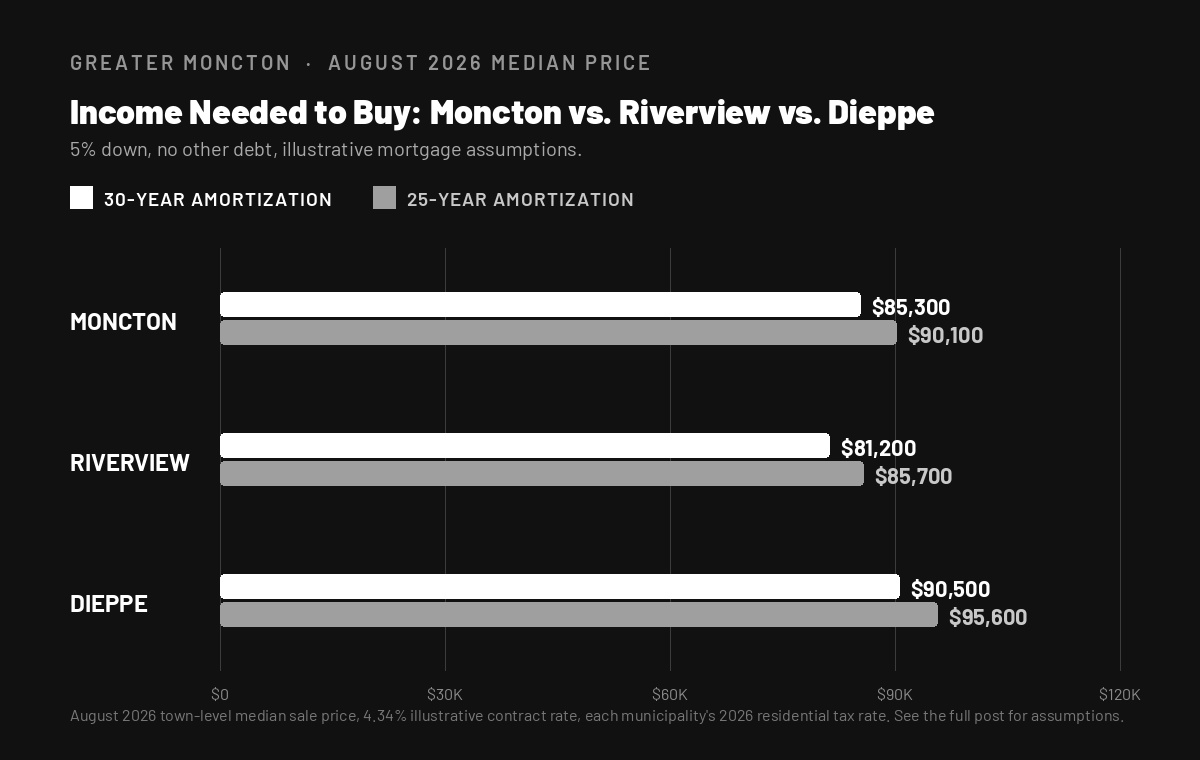
Property tax isn't what's driving that gap, the three towns' rates are within a hair of each other. Purchase price is doing all the work. Based on August's numbers, Riverview is the cheapest way into Greater Moncton by a meaningful margin, and Dieppe is the most expensive of the three.
Don't pack the moving truck yet, though.
WHY "MEDIAN RESIDENTIAL" DOESN'T MEAN "DETACHED HOUSE"
Those medians cover every residential property type that sold in August, not just detached houses, and the mix isn't the same in every town. Pull out single-detached sales specifically and the picture changes: Moncton's detached median was $358,000, on 49 sales. Riverview's was $372,450, on 14 sales. Dieppe's was $429,250, on just 9 sales. [Source: CREA, Moncton and Area Residential Market Activity, August 2026.]
Notice that Moncton's detached median actually came in below its overall residential median. That's not a typo, with only 90 total residential sales in Moncton that month against 49 detached ones, the other 41 sales (condos, townhomes, semi-detached, the rest of the mix) skewed the blended number upward. A single month's numbers can shift on a handful of sales, particularly in Riverview and Dieppe where detached sale counts were in the single and low double digits. Useful starting points, not gospel.
And even within Moncton, a bungalow in Moncton Centre and a newer two-storey in Moncton North aren't the same conversation. For the sub-area breakdown, my August 2026 Moncton market update covers all 13.
THE MORTGAGE STRESS TEST: WHY YOU DON'T QUALIFY AT THE RATE YOU'RE QUOTED
Here's where a lot of buyers get tripped up. You sit down with your broker or your bank's mortgage specialist, get quoted a rate, do the payment math in your head, and figure you're in good shape. Except that's not the rate most lenders actually qualify you at.
Federally regulated lenders, and every insured mortgage regardless of lender, have to qualify you at whichever is higher: your contract rate plus 2%, or 5.25%. That's the OSFI minimum qualifying rate, and it's been the standard for years. Offered a mortgage at 4.34%? You're qualified as if you were paying 6.34%. You're not actually paying that, you're being tested against it, on the theory that you should be able to absorb higher rates or a change in your finances without the whole thing falling apart.
It's why a payment that looks perfectly manageable on paper doesn't always translate into approval for the price you had in mind. Some credit unions and alternative lenders play by different rules, but the federal stress test is what most Moncton buyers are actually up against.
YOUR DOWN PAYMENT, AND WHY MORTGAGE INSURANCE COSTS MORE THAN PEOPLE THINK
Canada's minimum down payment rules are simple enough: 5% on the first $500,000, 10% on the portion between $500,000 and $1.5 million, and at least 20% above $1.5 million, where standard mortgage default insurance stops being available at all.
Here's the part people skip past. Put down less than 20% and you need mortgage default insurance, and that insurance isn't a rounding error. On the $374,090 example, 5% down is $18,705, leaving a base mortgage of $355,385. At a 25-year amortization, CMHC's premium at that loan-to-value is 4%, adding roughly $14,215 to the mortgage. Choose an eligible 30-year amortization instead, and CMHC tacks on a further 0.2-point surcharge, 4.2% total, about $14,926.
Your mortgage ends up bigger than your purchase price minus your down payment, because the premium usually gets rolled into the loan rather than paid separately at closing. You pay interest on it too.
SHOULD YOU CHOOSE A 25-YEAR OR 30-YEAR MORTGAGE
Since December 15, 2024, eligible first-time buyers can get a 30-year insured mortgage on resale or new construction, and buyers of new construction can access one even if they've owned before. Buyers putting 20% or more down may get a longer amortization through a conventional mortgage too, depending on the lender.
On the $374,090 example at 4.34%, 5% down, here's what actually changes:
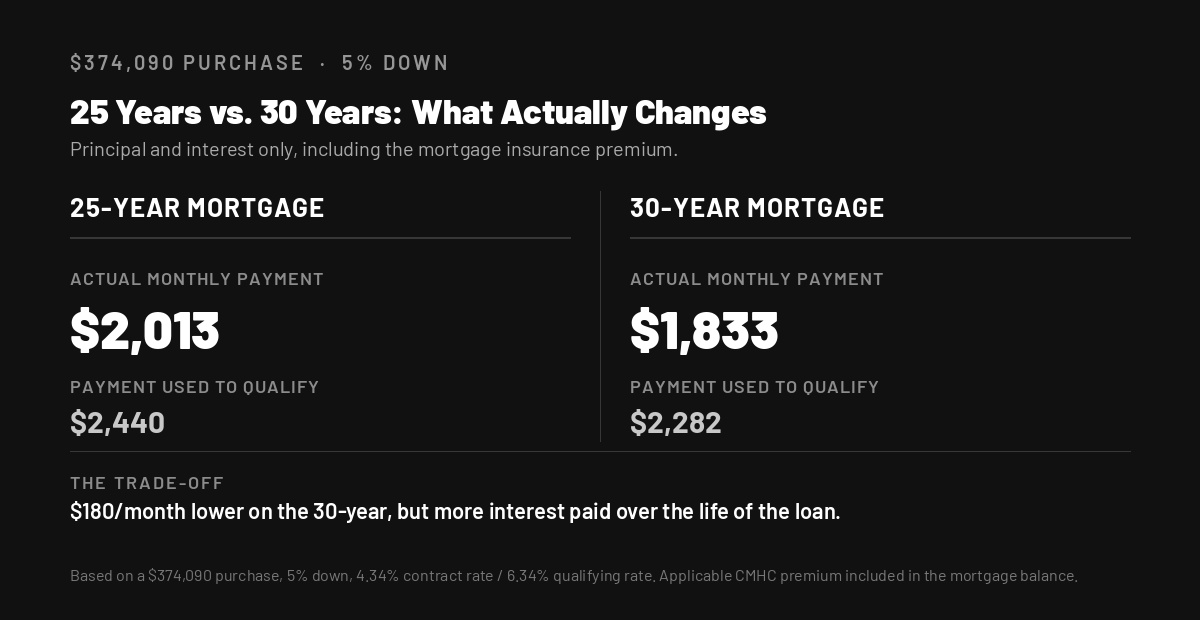
Thirty years drops your actual payment by about $180 a month and lowers the income needed to qualify. The trade-off is real: stretching the loan out means considerably more interest paid over its life, and because most Canadian mortgages renew before the amortization is up, your total interest cost down the road also depends on where rates go from here. If you're eligible, it's worth a real conversation with whoever's arranging your mortgage about both options, not a reflex toward the lower payment.
WHAT A CAR PAYMENT DOES TO YOUR BUYING POWER
Your mortgage isn't the only thing a lender looks at. They run two ratios: Gross Debt Service and Total Debt Service. GDS covers your housing costs, mortgage payment at the qualifying rate, property tax, heating, half of any condo fee, capped at 39% of gross household income. TDS adds everything else you owe, car payment, student loan, credit cards, lines of credit, capped at 44%.
This is where that new truck in the driveway starts causing real problems. Take the $374,090 home, 30-year amortization, no other debt: $86,400 in required income. Add a $600/month vehicle payment and that number jumps to $92,900, about $6,500 more, from one payment. If you're planning to buy in the next year or two, paying down debt before you apply does more for your buying power than almost anything else you actually control.
QUALIFYING FOR A MORTGAGE AND HAVING CASH TO CLOSE ARE TWO DIFFERENT THINGS
Getting approved is one hurdle. Having the cash in hand on closing day is another, and people conflate them constantly.
On the $374,090 example: 5% down is $18,705. New Brunswick's real property transfer tax, 1% of the purchase price or the assessed value, whichever is higher, adds another $3,741. That's $22,446 before legal fees, inspection costs, adjustments, moving expenses, or the emergency fund you'll want after the move. Your lawyer will give you an exact number, but budget for this separately from your down payment, it's the part people forget.
A NOTE ON PROPERTY TAXES, AND THE 2026 ASSESSMENT FREEZE
The numbers in this article use each town's 2026 municipal residential rate: $1.3614 per $100 of assessed value in Moncton, $1.3826 in Riverview, and $1.3650 in Dieppe. All three assume you're buying it as your principal residence and eligible for New Brunswick's Residential Property Tax Credit, which zeroes out the provincial portion on the first half-hectare around your home. For simplicity, these examples assume assessed value equals purchase price, your actual bill may differ.
One more thing worth knowing before you assume your tax bill will match the current owner's: New Brunswick froze most 2026 assessments, but sales and transfers are specifically excepted. Buy the place, and your assessment can update even while your neighbour's stays frozen. Don't take the seller's current tax bill as a preview of your own.
WHAT THIS MEANS IF YOU'RE PLANNING TO BUY
None of this replaces an actual mortgage pre-approval. What it gives you is a realistic starting point before you fall for a house that's outside your range. Talk to a mortgage specialist or broker early, find out your real buying power, and separately, decide what payment you're actually comfortable carrying. Those two numbers aren't always the same one.
If you're a first-time buyer or looking at new construction, ask specifically about the 30-year amortization, not every lender leads with it. And if you've got a house that needs to sell before this next purchase happens, the order of operations changes. I've written about how to structure buying before your current home sells if that's you.
Because what you can afford in one corner of Greater Moncton can look very different from what the same money buys ten minutes away.
A COUPLE OF QUICK ANSWERS
Can I buy a house in Moncton on $80,000 household income?
Potentially, yes. With 5% down, no other debt, and an eligible 30-year amortization, $80,000 gets you to roughly $345,000 in purchase price under these assumptions. That's real inventory, just not the regional average.
Does a bigger down payment lower the income I need?
Considerably. Move from 5% down to 20% on the $374,090 example and CMHC insurance disappears entirely. Required income drops to roughly $73,000 at 30 years or $77,000 at 25, assuming your lender offers the longer conventional amortization. Meaningful, if you've got the savings or equity to get there.
Thinking about buying in Greater Moncton and want to know what your budget can realistically get you?
Call or text 506-852-6477. No pressure, just straight answers.
Strong Roots - Smart Moves
Shane MacPherson, REALTOR®, eXp Realty

Comments:
Post Your Comment: