
THE MORTGAGE PAYMENT IS ONLY PART OF THE BILL
On October 28, the Bank of Canada raised its policy rate by a quarter of a percentage point. Naturally, the mortgage payment got most of the attention.
Fair enough. Borrowing costs matter. But if you’re trying to figure out whether you can comfortably afford a house, stopping at the mortgage payment leaves a fair bit of the conversation unfinished.
So I ran the numbers on a $350,000 home in Moncton. Then I added the bills that keep showing up after you get the keys. In this example, moving from a 3.45% mortgage rate to 3.70% adds about $43 a month. Property tax, power, insurance, water and sewer add about $832. Put another $250 aside for maintenance and you’re budgeting roughly $2,740 a month.
That’s with $35,000 down.
The mortgage payment matters. It just needs some company on the spreadsheet.
Jump to: The mortgage | Property tax | Power | Insurance | Water and sewer | Maintenance | The full monthly budget | Before you write an offer
THE EXAMPLE HOUSE
To keep the comparison useful, here’s one example all the way through:
$350,000 purchase price
10% down ($35,000)
25-year amortization
Owner-occupied, within Moncton’s standard municipal tax area
Electrically heated
$350,000 assessed value, assumed for the tax calculation
Municipal water and sewer
Purchase price and assessed value are separate numbers. They happen to match in this example. Don’t assume they will on the house you’re buying.
This is a planning example prepared in November 2026. It uses the mortgage rates advertised following the October 28 announcement, current electricity rates, and Moncton’s approved 2027 tax rate and water-budget example. It is not a prediction of mortgage rates next year.
Your house, your financing and your bills will be different. The point is to know what belongs in the budget before you commit to it.
THE MORTGAGE
With 10% down, the mortgage before default insurance is $315,000.
Using CMHC’s standard premium of 3.10% at that loan-to-value ratio, the insurance adds $9,765. If financed into the mortgage, that brings the total borrowed to $324,765. That insurance protects the lender. It is separate from your home insurance.
Here’s the monthly payment using the rates in Ratehub’s October 28 coverage:
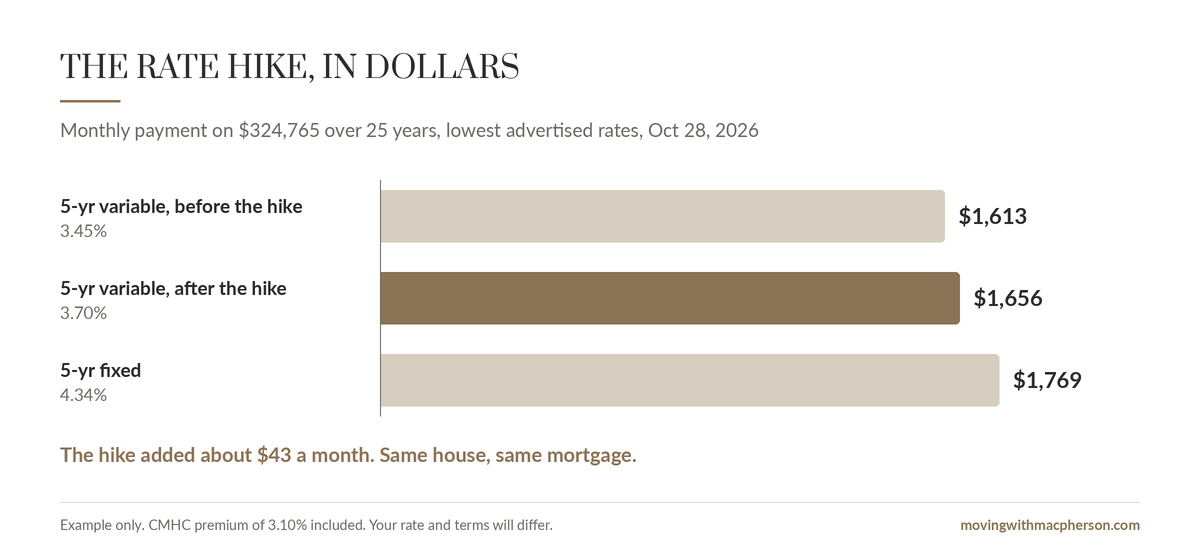
5-year variable before the hike, 3.45%: $1,613
5-year variable after the hike, 3.70%: $1,656
5-year fixed, 4.34%: $1,769
These are dated advertised rates, not a quote or a promise that every buyer qualifies.
The difference between the two variable-rate examples is about $43 a month.
One distinction matters here: an existing variable-rate mortgage doesn’t always get an immediate payment increase. Some have fixed payments, with more money going toward interest when rates rise. Others have payments that adjust. Know which one you’re signing up for.
Fixed mortgage rates are influenced by bond yields and lender pricing. They don’t automatically move by the same amount as the Bank of Canada’s policy rate.
Which mortgage fits your situation is a conversation with your mortgage specialist. If you’re waiting for rates to fall before having that conversation, start here: Should You Wait for Lower Rates to Buy in Moncton?
PROPERTY TAX
Moncton approved its 2027 budget on November 5, reducing the standard residential tax rate from $1.3614 to $1.2779 per $100 of assessed value.
At an assumed assessment of $350,000, the new rate works out to approximately $4,473 a year, or $373 a month.
A lower tax rate doesn’t automatically mean a lower tax bill. The assessment is the other half of the calculation.
That’s why copying the tax amount from a listing into your budget isn’t enough. The listing shows a bill associated with the seller’s ownership and the applicable tax year. Before relying on it, check the assessment, the tax year and whether the property’s owner-occupied treatment matches your intended use.
The question is what you should budget for after you buy.
Buying a rental or a second property? Read this separately: NB Non-Owner-Occupied Property Tax: The Real Numbers
POWER
Two houses can sell for the same price and have very different power bills.
For this example, I’ve used 1,350 kWh a month. At NB Power’s current urban residential rates of 15.84¢ per kWh plus a $30.82 service charge, that works out to about $281 with 15% HST.
That usage figure is an illustration. It is not a promise that an electrically heated $350,000 house will cost $281 a month to run.
The house’s size, insulation, heating equipment and the way people live in it all matter. So does whether the previous owner kept the place at 18 degrees or treated February like a tropical vacation.
Ask for 12 months of electricity usage and costs where available. Find out whether there are other heating bills as well. A power bill won’t tell you what someone spent on wood, propane or oil.
NB Power has also applied for increases averaging 5.5% a year over three years. Those increases are subject to regulatory approval, so they are not included in this example. They are a reason to leave some room in the budget.
If you’re planning upgrades, get actual installation prices and confirm any rebate eligibility before counting the savings.
Price the house as it is.
INSURANCE
For this example, I’ve used about $81 a month for home insurance. That comes from the $970 annual New Brunswick figure in MyChoice’s 2026 insurance outlook. It is a comparison-site benchmark, not a quote for this house.
Your actual premium could be considerably different.
Get a quote for the address and confirm the coverage, deductibles and any requirements the insurer wants addressed. Do that before waiving your insurance condition.
Finding out what the insurer needs after you’ve committed to the purchase is an unnecessarily exciting way to buy a house.
WATER AND SEWER
This belongs in the budget too.
Moncton’s approved 2027 budget gives an annual water and wastewater cost of $1,166 for an average household using 272 cubic metres a year. That includes the stated TransAqua treatment charge and works out to approximately $97 a month. Your actual bill depends on consumption and applicable charges.
It may not arrive monthly. You still need to put money aside for it monthly.
MAINTENANCE
I’ve added a $250 monthly maintenance allowance to this example. That’s $3,000 a year set aside for repairs and upkeep.
This is a budgeting choice, not a prediction or a guarantee that it will cover everything.
Some months you won’t touch it. Other months the hot water tank will have an opinion.
The right amount depends on the house. An older roof, aging heating system or inspection report with a lengthy repair list calls for a different plan than a home with those items recently replaced.
Known upcoming work needs its own budget. A monthly allowance won’t pay for a roof next spring if you’ve only made three deposits into it.
THE FULL MONTHLY BUDGET
Here’s the example with those costs included:
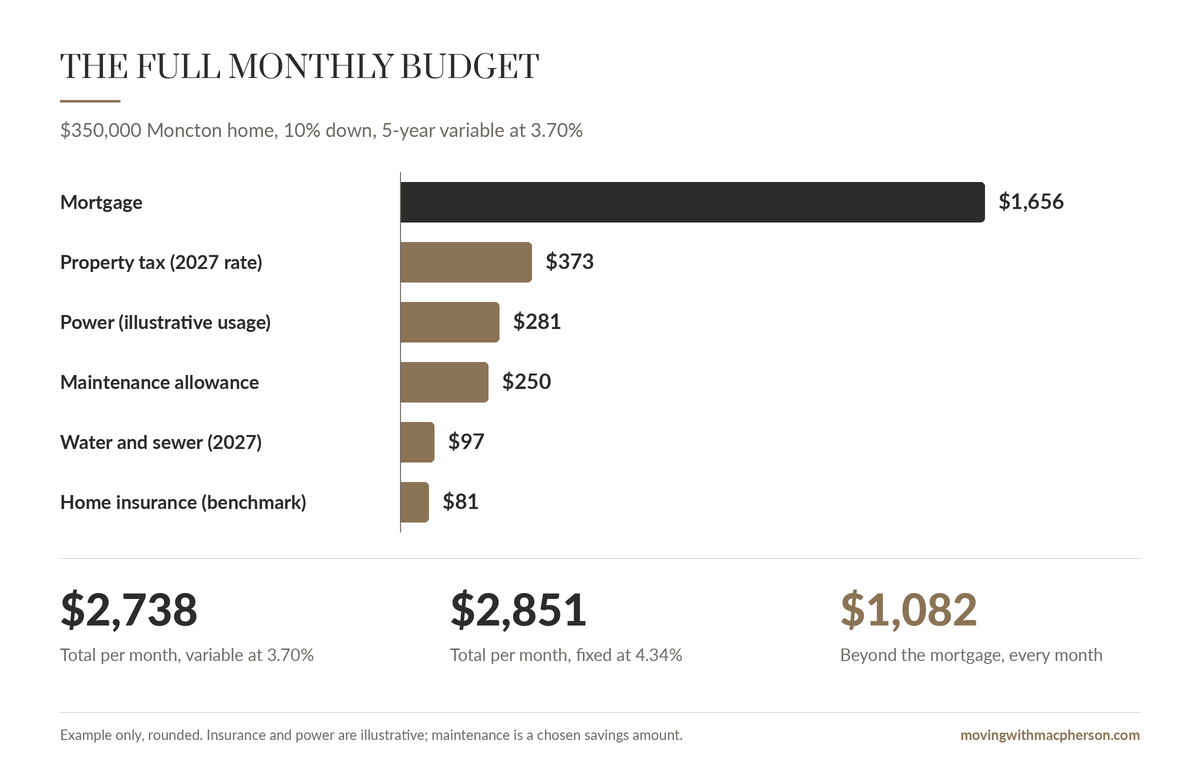
5-year variable example (3.70%)
Mortgage: $1,656
Property tax, using approved 2027 rate: $373
Power, illustrative monthly usage: $281
Home insurance benchmark: $81
Water and sewer, 2027 household example: $97
Estimated bills per month: $2,488
Maintenance savings allowance: $250
Total monthly budget: $2,738
5-year fixed example (4.34%)
Mortgage: $1,769
Same property tax, power, insurance and water: $832
Estimated bills per month: $2,601
Maintenance savings allowance: $250
Total monthly budget: $2,851
Rounded figures are used throughout. Annual and periodic costs are divided into monthly amounts for budgeting.
The rate change adds about $43 to the mortgage comparison. The other bills and maintenance allowance add about $1,082 beyond the mortgage payment.
That’s why I’d rather have this conversation before you fall in love with the kitchen.
This still excludes internet, any equipment rentals, condo fees if applicable, and property-specific expenses. The down payment, closing costs, moving expenses and immediate repairs also need money set aside separately.
If you’re working out whether your income supports the purchase, start here: What Salary Do You Need to Buy a House in Moncton?
BEFORE YOU WRITE AN OFFER
Five things to work through on any house you’re serious about, with anything outstanding addressed during your conditions:
Utility history. Ask for 12 months of electricity usage and costs where available, water bills, and details of any other heating fuel or equipment rentals.
Assessment and property tax. Check the current records, the applicable tax year and what could change under your ownership.
Insurance. Get a quote for the actual address and confirm any requirements before waiving the condition.
Financing. Use your mortgage specialist’s numbers, including the down payment, insurance premium, payment structure and closing funds.
Condition and value. Review comparable sales and use the inspection to identify expenses that belong in your budget now, rather than finding them later.
For the wider market picture: Moncton Market Update October 2026
A rate hike makes headlines. The power bill shows up in January whether anyone wrote about it or not.
If you want help running these numbers on a real house, call or text 506-852-6477.
Strong Roots - Smart Moves
Shane MacPherson | REALTOR® | eXp Realty | (506) 852-6477
Sources: Bank of Canada, October 28, 2026 rate decision; Ratehub, October 28 mortgage-rate coverage; CMHC mortgage loan insurance premium schedule; Financial Consumer Agency of Canada, mortgage interest and payment structures; City of Moncton, approved 2027 budget (CBC News); NB Power residential rate schedule and proposed three-year rate plan; MyChoice 2026 home insurance outlook.
Example only, prepared November 2026. Mortgage payments assume $324,765 financed over 25 years, monthly payments and semi-annual compounding. Actual lender calculations and terms may differ. The example combines dated mortgage rates, current electricity rates and approved 2027 municipal figures for planning purposes. Insurance and utility amounts are illustrative; the $250 maintenance allowance is a chosen savings amount. This is general information, not a mortgage approval, insurance quote or property-specific tax estimate.